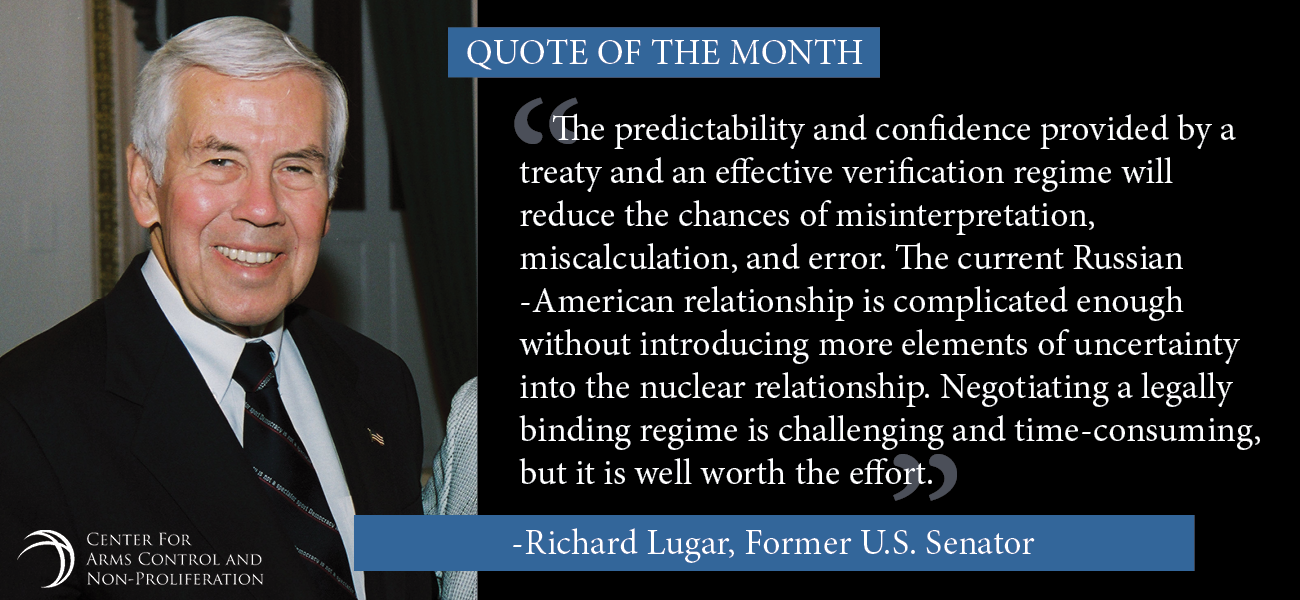
NEW START EXPIRES AS RUSSIA, UKRAINE, UNITED STATES MEET IN GENEVATuesday will mark four years since Russia began its illegal invasion of Ukraine. Russia, Ukraine and the United States held talks in Geneva last week but did not reach any resolutions, as Russia continues to demand land concessions that Ukraine will not accept. (We explained in a recent blog post why this is the wrong approach.) Further, there is disagreement about the future of the Zaporizhzhia Nuclear Power Plant, which Russia has controlled since the beginning of the invasion; Ukraine wants Russia to return it. This is all against the backdrop of the expiration of the New Strategic Arms Reduction Treaty (New START) on February 5. The last remaining bilateral deal constraining Russian and U.S. nuclear arsenals not only brought down the number of nuclear weapons, it provided for unprecedented transparency between the two countries’ arsenals and allowed each to make decisions based on real information rather than speculation. Now, for the first time in more than half a century, there are no legal obstacles to building their arsenals back up. Russian President Vladimir Putin said last year, perhaps disingenuously, that Russia will continue abiding by New START’s numerical weapons limits if the United States would; the Trump administration would not accept that proposal, saying arms control needs to be reimagined to include China. China continues to reject this idea; despite its rapidly growing arsenal, it still has thousands fewer weapons than the United States and Russia. We believe refusing to seek a replacement for New START with Russia simply because there is also no deal yet with China is foolish and short-sighted. Earlier this week, Russia reaffirmed this offer to maintain New START limits if the United States would, and the Trump administration should use the opening to initiate dialogue. In a statement about New START’s expiration, Senior Policy Director John Erath, a 30-year State Department veteran, said the end of New START does not have to mean the end of arms control. “While New START can’t be extended beyond today, Presidents Donald Trump and Vladimir Putin could decide to respect the numerical limits the treaty set on nuclear arsenals. They could also resume the treaty’s data exchanges and on-site inspections, in addition to implementing verification measures from other previous arms control treaties. Further, they could instruct their administrations to begin immediate talks on a new treaty to cover existing and novel systems and potentially bring in other nuclear powers, like China. Meanwhile, Congress could — and should — fund non-proliferation and global monitoring efforts while refusing to fund dangerous new nuclear weapons systems. Finally, the American public must insist that our leaders take this issue seriously. The diplomatic playbook to reduce the risks of nuclear arms racing and nuclear war exists and we can adapt it to better address challenges we face today.” Erath dove deeper into the idea of implementing verification measures from other previous arms control treaties in a new piece for the Bulletin of the Atomic Scientists. |
NEW NUKES OF HAZARD PODCAST EPISODE DISCUSSES NEW START EXPIRATION AND THE DOOMSDAY CLOCKDoes New START’s expiration signal the unceremonious end to nearly six decades of arms control efforts? No, explains Alex Bell, President and CEO of the Bulletin of the Atomic Scientists, in the Center’s new Nukes of Hazard podcast episode, because arms control is not a living thing, it is a tool that should be updated as circumstances change. In a short but wide-ranging interview, Bell, the former Deputy Assistant Secretary for Nuclear Affairs in the Bureau of Arms Control, Deterrence, and Stability at the Department of State, and the former Senior Policy Director here at the Center, spoke with Communications Director Anna Schumann about resetting the Doomsday Clock closer to midnight than ever before, what it’s like being at the negotiating table with China, what arms control looks like without New START and more. You can listen to the latest Nukes of Hazard episode online now or wherever you get your podcasts. |
UNITED STATES, IRAN MEET AS STRIKE CONCERNS PERSISTThe United States and Iran held indirect talks in Geneva two weeks ago to address the ongoing dispute over Iran’s nuclear program. Despite optimistic remarks from Iranian Foreign Minister Abbas Araghchi and the White House, the pressure to strike a deal over Iran’s nuclear program continues to mount. Just before the talks began, the Iranian Revolutionary Guard temporarily shut down the Strait of Hormuz for a live fire drill. This move was seen by many as a rare show of force meant as a message to the international community that “any strike on Iran would have global impact.” At the same time, the U.S. military is reportedly deploying additional forces in the region, supposedly giving President Donald Trump an option for an attack against Iran if a deal is not struck within the next few days. There are plans to meet again on Thursday and the region is on high alert as this situation continues to evolve. |
EUROPEAN ALLIES DISCUSS GETTING NUKES OF THEIR OWNGermany and France have met to discuss creating a joint European nuclear deterrent to supplement the U.S. nuclear umbrella in Europe. Poland’s president has just said he believes Poland should consider a nuclear arsenal to stave off the Russian threat. And Sweden’s prime minister said he is among the world leaders openly discussing growing Europe’s nuclear deterrent. Currently, France and the United Kingdom are the only European countries with nuclear weapons, with a few hundred weapons apiece. The United States’ nuclear deterrent has covered Europe for decades, but officials including those in Germany and Sweden have cited a loss of trust in the United States as reason for these new conversations. For its part, the Trump administration has said it does not support “friendly proliferation” and that the United States will continue to provide its extended nuclear deterrent. Last year, Research Analyst Connor Murray and then-Scoville Fellow Marlena Broeker wrote in Just Security that doubts concerning U.S. reliability should not lead to a European nuclear deterrent following similar conversations at the Munich Security Conference last year. A European deterrent would be “economically, technically and politically inadvisable,” they write. |
NORTH KOREA SIGNALS INCREASING DEFENSE PRIORITIES AS SOUTH KOREA ANNOUNCES TEAM TO NEGOTIATE WITH UNITED STATESIn February, attention shifted to the lead-up to North Korea’s upcoming party congress, the first since 2021. In public remarks, Kim Jong Un highlighted what he described as major gains in military power over the past five years while acknowledging economic shortfalls — an implicit signal that defense priorities will again dominate the regime’s next planning cycle. Meanwhile in Seoul, South Korea’s foreign ministry announced the creation of a dedicated team to handle negotiations with the United States on nuclear-powered submarine cooperation, reflecting Seoul’s growing interest in more advanced undersea capabilities amid persistent concerns about North Korea’s evolving arsenal. |
TRUMP ADMINISTRATION CLAIMS CHINA CONDUCTED NUCLEAR TEST IN 2020, GIVES INSIGHT INTO TRUMP’S DANGEROUS TESTING COMMENTS LAST YEARUnder Secretary of State for Arms Control and International Security Tom DiNanno gave a speech to the United Nations Conference on Disarmament in which he claimed the United States had evidence of a secret low-yield Chinese explosive nuclear weapons test conducted in 2020 at Lop Nur. Assistant Secretary of State for Arms Control and Non-Proliferation Christopher Yeaw echoed this position. Speaking at the Hudson Institute, Yeaw provided some additional detail about the suspected Chinese test and identified this information as the basis for President Trump’s ambiguous comments on testing last year. Beijing denies this claim, and independent analysts cautioned that available satellite imagery and seismic data remain inconclusive. It seems unlikely that a nuclear test of any significance would go undetected. The allegation followed the expiration of New START and was framed by U.S. officials as evidence of why China should be included in future arms control arrangements, and as rationale for a resumption of U.S. explosive nuclear testing. As Research Analyst Shawn Rostker made clear in a piece published last year by Just Security, no one would benefit more from a global resumption of explosive nuclear tests than China. Encouragingly, Yeaw highlighted the importance of the Nuclear Non-Proliferation Treaty’s upcoming Review Conference as an opportunity for progress. |
SENTINEL ICBM, PLAGUED BY DELAYS AND COST OVERRUNS, EXPECTED WITHIN 10 YEARSThe much-delayed and over-budget Sentinel intercontinental ballistic missile (ICBM) program is expected to deliver its initial capability by the early 2030s, the Pentagon announced last week. The U.S. Air Force’s modernization of the land-based leg of the nuclear triad is forcing a rethink about how its missiles are protected. As the new LGM-35A Sentinel ICBM and its associated infrastructure take shape, units responsible for guarding silo fields will need updated tactics, techniques and procedures because the new silos differ significantly from those used for the aging Minuteman III force. A recent Government Accountability Office report noted this shift alongside ongoing restructuring of the Sentinel program after years of delays and cost overruns. |
FOLLOW US ON SOCIAL MEDIAWe are on X (formerly known as Twitter), Facebook, Instagram, Threads and Bluesky. Follow us for the latest national security and nuclear weapons news on your favorite platforms |
CONSIDER BECOMING A MONTHLY OR ROUND-UP DONORWith only a few clicks today, you can set the Center up for long-term success by setting up monthly donations. You could also consider making a one-time gift or joining our round-up program through which you can donate change from your purchases, up to your pre-set amount, each month.
|