
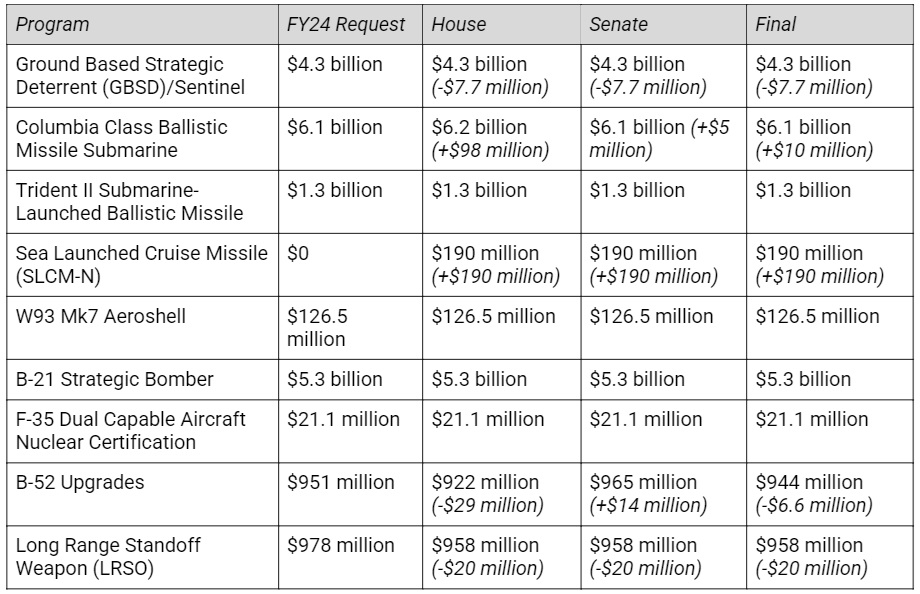
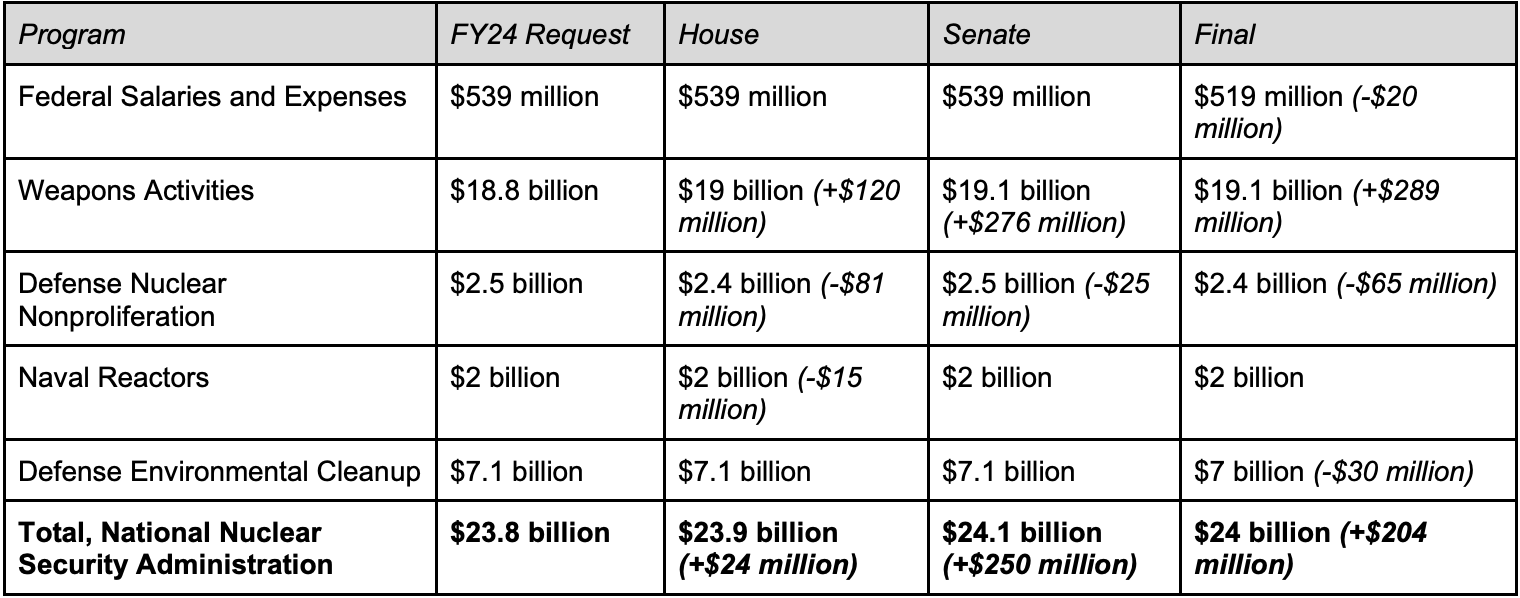
- Table numbers in parentheses are increases or decreases from the FY24 Request
- FY24 requested levels other than the toplines come from the Center for Arms Control and Non-Proliferation’s Fiscal Year 2024 Defense Budget Request Briefing Book
- Numbers may not add due to rounding
Total National Defense Discretionary Spending (050)
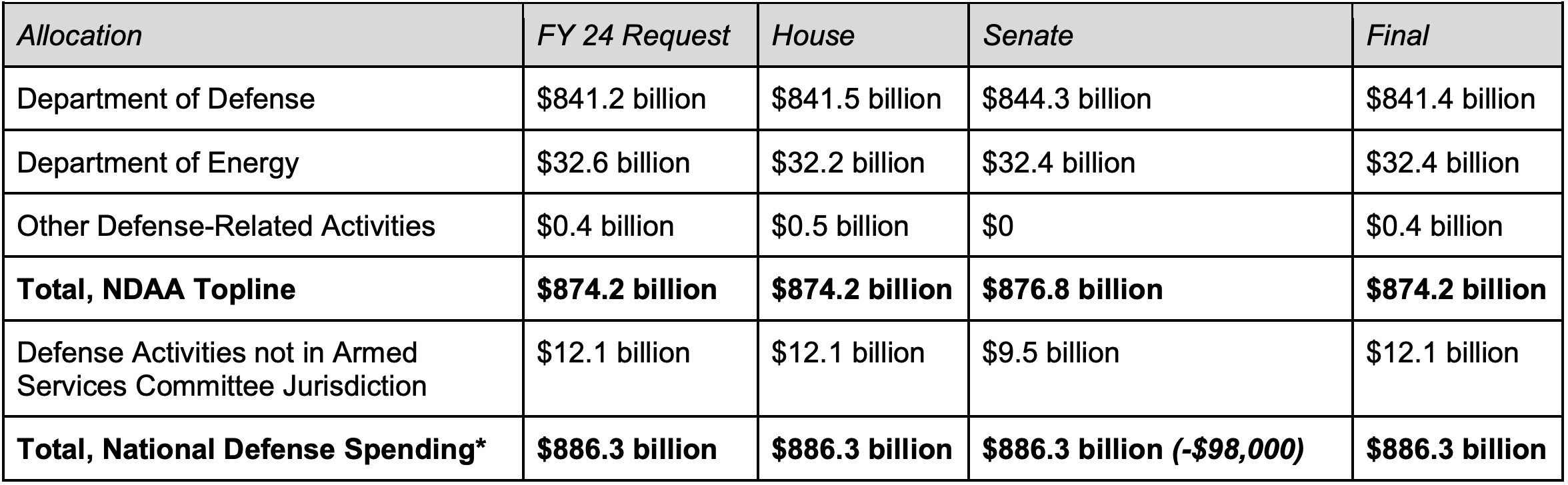
*Does not include mandatory spending
** Total increase from FY23 NDAA topline is $29 billion, or 3.3%
DOD Nuclear Weapons Funding Request for Select Programs
National Nuclear Security Administration (NNSA) Request
DOE Nuclear Weapons Funding Request for Select Programs
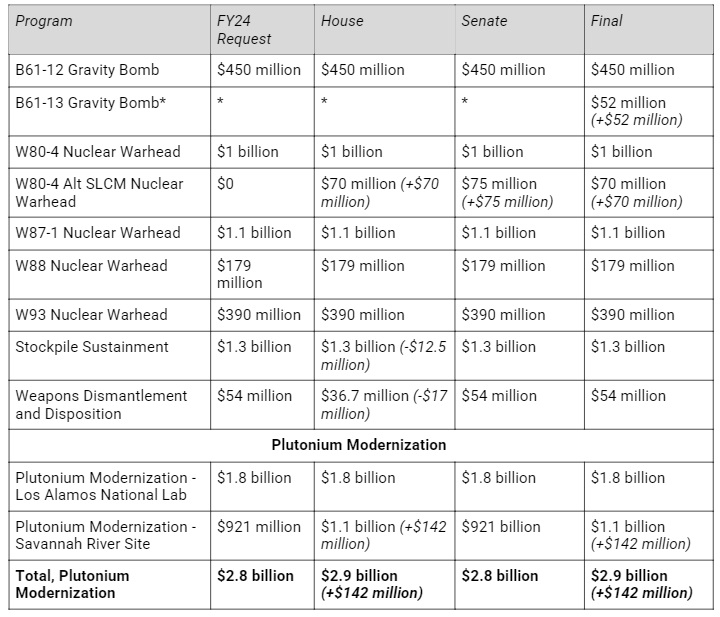
*The Biden Administration announced plans to develop the B61-13 gravity bomb in October 2023. The conference report lists both a request and final number, but no request for funding could be located in the NNSA’s budget documents.
Select Provisions Related to Nuclear Weapons
➤ Prohibition on New START Notification
House: Prohibits providing Russia with notifications under the New START Treaty (Sec. 1234)
Senate: No similar provision
Final: Adopts House provision but allows for notifications if the Secretaries of Defense and State concur that Russia is providing New START notifications, or that it is in U.S. national security interest to unilaterally provide notifications (Sec. 1246)
➤ NC3 Major Force Program
House: Requires the Department of Defense to establish a major force program for nuclear command, control and communications (NC3) programs (Sec. 1631)
Senate: No similar provision
Final: Adopts the House provision (Sec. 1631)
➤ MIRV Capability
House: Extends existing statutory requirements related to the ability of the current Minuteman III intercontinental ballistic missile to be capable of deploying multiple independently targeted reentry vehicles to the Sentinel (Sec. 1633)
Senate: No similar provision
Final: Adopts the House provision (Sec. 1638)
➤Deployed ICBMs
House: Prohibits reducing the number of deployed intercontinental ballistic missiles below 400 (Sec. 1638)
Senate: Prohibits reducing the number of deployed intercontinental ballistic missiles below 400 (Sec. 1611)
Final: Adopts House provision (Sec. 1646)
➤ Sentinel ICBM Missile Silos
House: No similar provision
Senate: Requires refurbishment and operability of 150 ICBM silos each at F.E. Warren Air Force Base, Malmstrom Air Force Base and Minot Air Force Base (Sec. 1612)
Final: Adopts Senate provision (Sec. 1641)
➤ Sentinel ICBM Acquisition
House: No similar provision
Senate: Authorizes the use of multi-year procurement authority for the Sentinel ICBM program (Sec. 1613)
Final: Adopts Senate provision with an amendment requiring a report assessing acquisition authorities, including multi-year procurement authority, necessary to ensure the Sentinel program meets current timelines (Sec. 1634)
➤ Decreased ICBM Warhead Upload Time
House: No similar provision
Senate: Requires STRATCOM and the Air Force to develop a plan to decrease the upload time for warhead to the ICBM force to address identified limitations at Malmstrom, F.E. Warren, and Minot Air Force Bases (Sec. 1614)
Final: Adopts Senate provision with additional amendments requiring additional coordination and and explanation as part of the plan (Sec. 1650)
➤ SLCM-N Program of Record
House: Establishes a SLCM-N program within the Department of Defense for the missile and its associated warhead, the W80-4 ALT (Sec. 1641)
Senate: Establishes a SLCM-N program within the Department of Defense for the missile and its associated warhead, the W80-4 ALT. Also requires initial operation capability for the SLCM-N no later than FY 2035 ( Sec. 1618)
Final: Adopts the Senate provision with an amendment requiring a report within 180 days assessing the ability to effectively deploy a nuclear-armed, sea-launched cruise missile from a Virginia-class submarine or other platforms that the Secretary considers appropriate. The amendment would further limit FY2024 funding for the travel by the Secretary of the Navy to not more than 90% made available until an additional report from the FY23 NDAA is completed (Sec. 1640)
➤ SLCM-N Quarterly Reports
House: Requires quarterly reports on SLCM-N progress (Sec. 1642)
Senate: No similar provision
Final: Includes the quarterly reports within SLCM-N program of record section (Sec. 1640)
➤ Acceleration of Nuclear Modernization
House: Requires a DoD report on the ability to accelerate nuclear modernization (Sec. 1644)
Senate: No similar provision
Final: Does not adopt the House provision
➤ Annual Report on U.S. Nuclear Modernization
House: No similar provision
Senate: Requires an annual independent analysis of acquisition, construction, and recapitalization programs under the Department of Defense and NNSA to modernize U.S. nuclear forces (Sec. 1620)
Final: Adopts the Senate provision (Sec. 1633)
➤ B83 Retirement
House: Prohibits retirement of more than 25% of B83-1 bombs until 90 days after the hard and deeply buried targets study required by the FY23 NDAA is completed (Sec. 1639)
Senate: Prohibits retirement of more than 25% of B83-1 bombs until the hard and deeply buried targets study required by the FY23 NDAA is completed (Sec. 1622)
Final: Adopts the House provision with an amendment that extends the existing prohibition related to deactivation, dismantlement, or retirement of the B83-1 nuclear gravity bombs, and would also authorize activities necessary to field near-term capabilities to address hard and deeply buried targets (Sec. 1636)
➤ LEU Fuel Research
House: Prohibits use of funds for LEU naval fuel research (Sec. 1640)
Senate: Limits the use of funds for LEU naval fuel research until it is determined by DOE and DOD that LEU fuel should be pursued and will not impact operability of submarines and cost of refueling (Sec. 3111)
Final: Adopts the House provision (Sec. 3124)
➤ ARIES Expansion Prohibition
House: No similar provision
Senate: Prohibits expansion of the Advanced Recovery and Integrated Extraction System (ARIES) process at Los Alamos until it reaches the capacity to produce 30 plutonium pits per year (Sec. 3112)
Final: Adopts the Senate provision with an amendment that limits expansion of ARIES while allowing continued operations until the Administrator certifies the base capability to produce 30 war reserve plutonium pits per year (Sec. 3116)
➤ Pit Modernization Management
House: No similar provision
Senate: Requires the NNSA Administrator to manage the Plutonium Modernization Program under the same management category as other weapons modernization programs to increase internal controls over the program (Sec. 3113)
Final: Adopts the Senate provision with an amendment that directs NNSA to manage plutonium modernization using an integrated master schedule and a life cycle cost estimate that fully meets GAO best practices for both schedule development and cost estimating (Sec. 3117)
➤ Pit Aging Study
House: Requires an independent assessment on plutonium aging (Sec. 3133)
Senate: No similar provision
Final: Does not adopt the House provision
Missile Defeat and Defense Funding Authorization for Select Systems
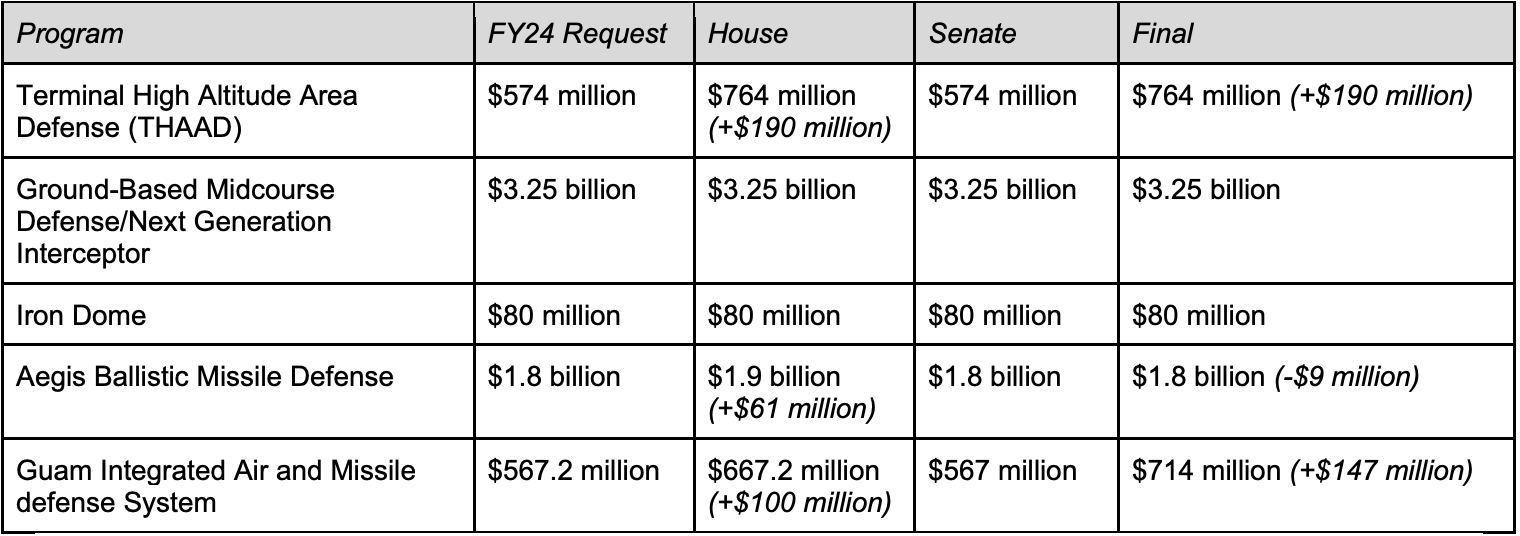
Select Provisions Related to Missile Defense
➤ Indo-Pacific Integrated Air and Missile Defense Architecture
House: Requires the Secretary of Defense to provide a report on the integrated air and missile defense sensor architecture of the U.S. Indo-Pacific Command (Sec. 1666)
Senate: Requires the establishment of an integrated air and missile defense architecture for the Indo-Pacific (Sec. 1637)
Final: Adopts the Senate provision (Sec. 1669)
➤ Update to Missile Defense Policy
House: Updates U.S. missile defense policy to identify credible nuclear capability as the foundation of strategic deterrence (Sec. 1662)
Senate: Updates U.S. missile defense policy to eliminate the reference to “rogue states” (Sec. 1638)
Final: Adopts the House provision with an amendment that states the United States will rely on nuclear deterrence to address more sophisticated and larger quantity near-peer intercontinental missile threats to the homeland (Sec. 1663)
➤ Additional Homeland Missile Defense Site
House: Limits funding for the Office of the Under Secretary of Defense for Policy, for travel, pending submission of a report on an additional missile defense interceptor site at Fort Drum, New York required by the FY 2023 NDAA (Sec. 1665)
Senate: No similar provision
Final: Does not adopt the House provision
Miscellaneous Programs and Provisions of Interest
➤ Pay Raise
Authorizes a 5.2% pay raise for service members and civilians
➤ CTR Funds
House: Authorizes $351 million, the requested level, for the Defense Cooperative Threat Reduction Program (Sec. 1683)
Senate: Authorizes $351 million, the requested level, for the Defense Cooperative Threat Reduction Program (Sec. 1401)
Final: Provision is included (Sec. 1683)
Senate Passage
The bill was passed by the Senate in an 87-13 vote.
House Passage
The bill was passed by the House in a 310-118 vote.
Sources
Center for Arms Control and Non-Proliferation comparative summary of HASC and SASC approved bills