 By Emma Sandifer
Do you ever wonder how nuclear weapons impact your own community?
I did, so I spent one year mapping the footprint of nuclear weapons across our neighborhoods, and I was left surprised…and encouraged.
In the spring of last year, I was named one of Ploughshares Foundation and Horizon 2045’s Nuclear Futures Fellows. Out of this fellowship, and a year of hard work, came the Neighbors Against Nukes map.
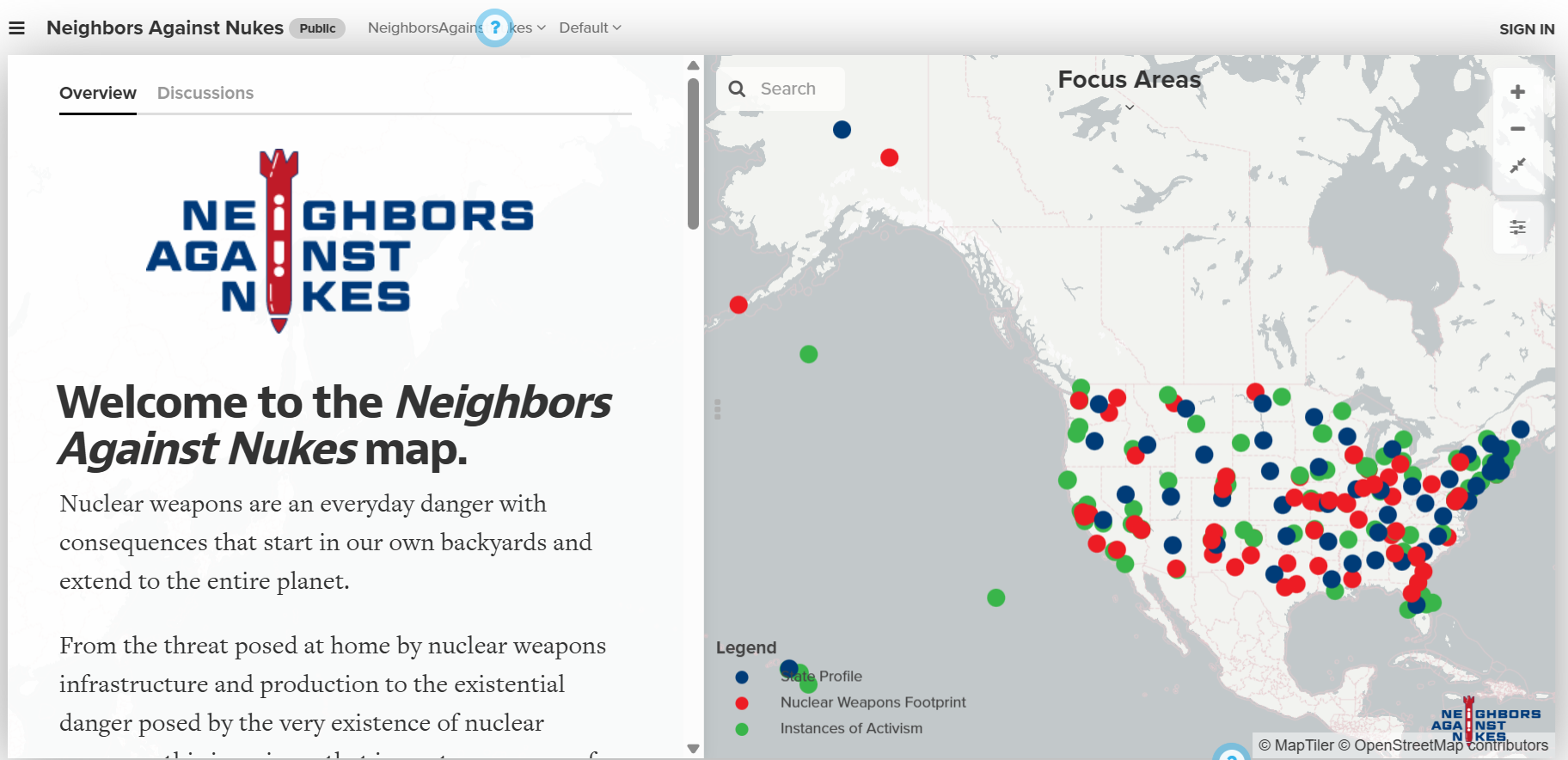
This map tracks three elements:
-
- The footprint of nuclear weapons in your own backyard: These can be national labs where nuclear weapons are made, military bases where they are stored or deployed, or sites of contamination caused by nuclear weapons production, storage and testing.
- The ways that your neighbors have fought against nuclear weapons: These are famous protests of all kinds, be it peace voyages, cross-continent pilgrimages, or demonstrations at missile silos. These are also instances of local political action against nukes such as nuclear-weapons-free zones or anti-nuclear weapons resolutions.
- Strategies for carving your own path in the fight against nuclear weapons: In each state profile, you will find educational resources, local organizations to get involved with, sample letters to send to your representatives and more!
The almost 250 points on this map seek to tell an overarching story, one that is surprisingly characterized by determination and hope: faced with a pattern demonstrated by the U.S. government in which it prioritized nuclear weapons production over the health and security of its communities, activists and everyday people from all over the country have relentlessly taken it upon themselves to protest the impact of the nuclear weapons enterprise on the landscape of the United States.
As I wrote for the Ploughshares Fund Story Center:
“Using the map, you can see that in Montana, university professors launched a campaign of civil disobedience. In Tennessee, activists stood on the railroad tracks to stop a train carrying nuclear warheads. In Massachusetts and Iowa, students held strikes against nuclear weapons. In Michigan, demonstrators ‘exorcised’ government buildings involved with contracts for nuclear weapons manufacturing. In Nevada, activists perform the ’14 Nuclear Stations of the Cross’ and, in Maryland, nonprofit organizations come together to hold an annual Hiroshima-Nagasaki Commemoration. Towns and cities across the country have declared themselves nuclear weapons free zones and activists have walked hundreds of miles and sailed boats in protest.
And these are just the instances that were documented, moments that showed up in newspapers, court transcripts, or oral histories. There are countless other moments that happen at kitchen tables, in classrooms, and casual conversation.”
Check out the Neighbors Against Nukes map to chart your own path toward reducing the threats posed by nuclear weapons and take an active role in safeguarding your community.
While this project is separate from my work at the Center, I am grateful for the space the Center allowed me to pursue it. I hope it will prove useful in our efforts to educate Congress, the press and people like you about just how vast — and how local — America’s nuclear enterprise really is. Nuclear weapons touch all of us; this project is proof of that.