By Amanda Waldron
International Business Times Cites Ed Levine’s Analysis of Kirk-Menendez Bill
How the U.S. Midterms Could Affect the Future of Iran Nuclear Talks By Erin Banco November 4, 2014 The premise of the bill is that Iranian sanctions can be averted only if the Obama administration provides specific certifications every 30 days and if Iran implements the terms of the so-called Joint Plan Of Action. The […]
No Iran Deal is Not a Success
By Amanda Waldron
Front and Center
FRONT & CENTER
An update on arms control, national security & politics from the Center for Arms Control and Non-Proliferation.
October 11-October 26 WHAT’S NEW:
An Evening in Boston
Save the date: On the evening of November 6th, we’ll be in Boston for a night of expert analysis, substantive discussion, and fun! We’ve invited Massachusetts Senator Ed Markey, among other notable speakers, to lead our Election Forum and Reception on the Future of National Security. Best part? It’s free! We hope you can join us. Space is limited, so RSVP today.
READ:
Growth in Pentagon Spending Since 2001
We’ll start with the good news: the overall trend for the U.S. defense budget is on a downward slope. That said, the U.S. is spending $7-10 million per day on its new war in the Middle East against the Islamic State, meaning Congress may decide to up the ante in Fiscal Year 2015. Check out our reporton the center site to learn more. [10/20]

Window of Opportunity to Change US Nuclear Spending:
“Folks are understandably confused by the juxtaposition of the exorbitant price tag attached to current plans to upgrade all three legs of the triad at once, and the waning U.S. budget,” writes Katie McCarthy on the Nukes of Hazard blog. That’s why, rather than modernize the triad, the time is now to reassess exactly what we need and what we can afford. [10/24]
But What About Grandma?
It’s a well-known fact that Western sanctions against the Islamic Republic of Iran were key in bringing the Iranians to the negotiating table. What’s less well-known is exactly how these sanctions have impacted your everyday Iranian citizen. Sarah Tully provides a few personal accounts of the effects of these sanctions and the domestic pressure that has arisen. Rouhani may have no choice but to stay at the table until a deal is reached. [10/21]
BE SOCIAL:
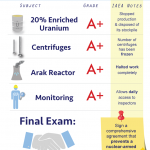
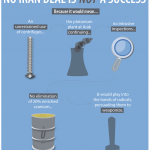
Infographic: Not Getting a Deal Won’t Make Us Any Safer
Remember BiBi’s infamous “red line?” Well, this week, one former US official put the kibosh on Israel’s “no deal is better than a bad deal” rhetoric. The highly respected former Under Secretary of State, Ambassador Stuart Eizenstat told the Jerusalem Post that failing to get an Iran deal should not be considered a success. We loved Eizenstat’s argument so much, we made an infographic. Don’t forget to share it on Facebook, Twitter, or by email! [10/24]


It’s better this way
Two years ago, Israeli Prime Minister Benjamin Netanyahu stood before the UN General Assembly in New York, and before the world, with a cartoon bomb. He warned that Iran was dangerously close to acquiring enough 20 percent enriched uranium for one bomb.
Much like Wile E. Coyote, Israel knew it was standing just a little too close to the fuse.
All Looney Tunes references aside, Netanyahu’s point was well taken. It was just two years before that Jeffrey Goldberg warned the world of an impending attack that had the potential to draw the U.S. into yet another conflict in the Middle East. Netanyahu was, quite literally, illustrating the fact that when Iran’s program reached a critical mass, Israel would be forced to react.
Today we have, in fact, found ourselves in yet another conflict in the Middle East, but not the one we thought. Iran, long the problem child of the region with an expanding nuclear program and intransigent leader, has not only inked an interim agreement with world powers constraining its nuclear program, so far it has bucked all expectations by complying with the deal.
But negotiators have less than a month to agree on a path forward, and some have speculated (including Netanyahu himself) that no deal at all might be better than a deal that comes to some compromise on Iran’s nuclear infrastructure.
Contrary to this belief, the facts speak for themselves. Thursday, former undersecretary of state Stu Eizenstat told The Jerusalem Post, “No deal is not a success, because it means an unrestrained use of centrifuges, the Iranian plutonium plant at Arak continuing, no intrusive inspections, no elimination of 20-percent enriched uranium, and less likelihood of eliminating weaponization.”
Eizenstat warned that, “[A deal] would not be a bouquet of roses. It has a lot of thorns in it. But the alternative is nothing but thorns.”
His words echo remarks from current undersecretary of state and P5+1 negotiator Wendy Sherman, delivered the same day, that:
…the world is clearly better off now than it would have been if the leaders on both sides had ignored this opening. With all that is going on in the Middle East today, an Iranian nuclear program that was not frozen but instead rushing full speed ahead toward larger stockpiles, more uranium enrichment capacity, the production of weapons-grade plutonium, and less transparency would hardly have been a stabilizing factor.
Sherman then went into further detail, specifying that the administrations goals in reaching a final agreement:
Our goal now is to develop a durable and comprehensive arrangement that will effectively block all of Iran’s potential paths to fissile material for a nuclear weapon. Such an arrangement would bar Iran from producing fuel for a weapon with either uranium or plutonium. Through inspections and monitoring, it would also offer the best method to prevent the covert processing of these materials and make any effort by Tehran to turn away from its obligations so visible and so time-consuming that the attempt would not succeed.
Sherman’s and Eizenstat’s comments drive home the fact that failure to reach an agreement would take the U.S. and the world back to a state of unrestrained, unverified progress toward an Iranian nuclear weapon.
Safeguards implemented as part of the current agreement allow access that ensures Iran’s nuclear program remains under lock and key. Some might argue that to sign a deal with a country we do not trust is irresponsible or naïve, but it is precisely because we do not trust Iran that we must have a deal.
To walk away from that access would simply be too much of a risk.

