• Skip to main content
  • Skip to primary sidebar
  • Skip to footer

Center for Arms Control and Non-Proliferation

Center for Arms Control and Non-Proliferation

  • Policy Issues
    • Fact Sheets
    • Countries
    • Nuclear Weapons
    • Non-Proliferation
    • Nuclear Security
    • Biological & Chemical Weapons
    • Defense Spending
    • Missile Defense
    • No First Use
  • Nukes of Hazard
    • Podcast
    • Blog
      • Next Up In Arms Control
    • Videos
  • Join Us
  • Press
  • About
    • Staff
    • Boards & Experts
    • Jobs & Internships
    • Financials and Annual Reports
    • Contact Us
  • Donate
  • Search
You are here: Home / Archives for Missile Defense / Factsheets on Missile Defense

July 18, 2023

Summary: Fiscal Year 2024 National Defense Authorization Act (S. 2226) as passed by the Senate Committee on Armed Services
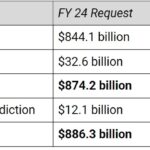
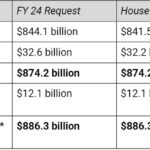
Table numbers in parentheses are increases or decreases from the FY24 Request FY24 requested levels other than the toplines come from the Center for Arms Control and Non-Proliferation’s Fiscal Year 2024 Defense Budget Request Briefing Book Numbers may not add due to rounding Total National Defense Discretionary Spending (050) *Does not include mandatory spending   […]
Posted in: Factsheets & Analysis on Nuclear Weapons, Factsheets & Analysis on Nuclear Weapons Spending, Factsheets & Analysis on Pentagon Budget, Factsheets on Missile Defense, Nuclear Weapons Spending, Pentagon Budget, Security Spending, United States

April 4, 2023

Fiscal Year 2024 Defense Budget Request Briefing Book

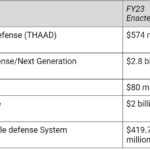
FY23 enacted levels come from FY24 President’s Budget documents and the Center for Arms Control and Non-Proliferation’s Final Summary: Fiscal Year 2023 Omnibus Appropriations Bill  Table numbers in parentheses are increases or decreases from the FY23 Enacted Level unless otherwise specified.  Numbers may not add up due to rounding  Total National Defense Discretionary Spending Request […]

Posted in: Factsheets & Analysis on Nuclear Weapons, Factsheets & Analysis on Nuclear Weapons Spending, Factsheets & Analysis on Pentagon Budget, Factsheets on Missile Defense, Missile Defense, Nuclear Weapons Spending, Pentagon Budget, Security Spending, United States

October 21, 2021

Summary: Fiscal Year 2022 National Defense Authorization Act (S. 2792)

as reported by the Senate Armed Services Committee (Table numbers in parentheses are increases or decreases from the FY22 Request; numbers may not add due to rounding)    Total National Defense Discretionary Spending (050)  Allocation  FY21 Enacted  FY22 Request  SASC Authorization  DoD Discretionary Base  $635.5 billion  $715 billion  $740.3 billion   DoE Discretionary Base  $26.6 billion  $27.9 […]

Posted in: Factsheets & Analysis on Nuclear Weapons, Factsheets & Analysis on Nuclear Weapons Spending, Factsheets & Analysis on Pentagon Budget, Factsheets on Missile Defense, Nuclear Weapons Spending, Pentagon Budget, Security Spending, United States

October 7, 2021

Summary: Fiscal Year 2022 National Defense Authorization Act (H.R. 4350) as Passed

As passed by the House of Representatives (Table numbers in parentheses are increases or decreases from the FY22 Request) Total National Defense Discretionary Spending (050) Allocation FY21 Enacted FY22 Request HASC Authorization DoD Discretionary Base $635.5 billion $715 billion $739.5 billion DoE Discretionary Base $26.6 billion $27.9 billion  $28.2 billion Overseas Contingency Operations (OCO)* $69 billion […]

Posted in: Factsheets & Analysis on Nuclear Weapons, Factsheets & Analysis on Nuclear Weapons Spending, Factsheets & Analysis on Pentagon Budget, Factsheets on Missile Defense, Nuclear Weapons Spending, Pentagon Budget, Security Spending, United States

April 2, 2021

Fact sheet: U.S. Ballistic Missile Defense

UPDATED: May 21, 2025 Ballistic missile defense systems seek to defend a given area from attack by locating and tracking an incoming ballistic missile and then launching an interceptor to destroy the missile before it can reach its target. All U.S. interceptors are made up of a booster rocket and a kill vehicle. While most […]

Posted in: Factsheets on Missile Defense, Missile Defense, Nuclear Weapons

  • « Go to Previous Page
  • Page 1
  • Page 2
  • Page 3
  • Page 4
  • Page 5
  • Go to Next Page »

Primary Sidebar

Recent Posts

  • Reflections On My Summer Internship: Lyle Seeligson August 6, 2026
  • The United States has a responsibility to uphold non-proliferation norms. Here’s how it can. July 29, 2026
  • US-Saudi nuclear deal could increase proliferation risk: arms control expert | ABC NEWS July 23, 2026
  • Why a Saudi nuclear deal is a perfect metaphor for Trump’s presidency July 23, 2026
  • 81 years after first atomic test, AI increases nuclear risks July 16, 2026

Footer

Center for Arms Control and Non-Proliferation

820 1st Street NE, Suite LL-180
Washington, D.C. 20002
Phone: 202.546.0795

Issues

  • Fact Sheets
  • Countries
  • Nuclear Weapons
  • Non-Proliferation
  • Nuclear Security
  • Defense Spending
  • Biological and Chemical Weapons
  • Missile Defense
  • No First Use

Countries

  • China
  • France
  • India and Pakistan
  • Iran
  • Israel
  • North Korea
  • Russia
  • United Kingdom

Explore

  • Nukes of Hazard blog
  • Nukes of Hazard podcast
  • Nukes of Hazard videos
  • Front and Center
  • Fact Sheets

About

  • About
  • Meet the Staff
  • Boards & Experts
  • Press
  • Jobs & Internships
  • Financials and Annual Reports
  • Contact Us
  • Council for a Livable World
  • Twitter
  • YouTube
  • Instagram
  • Facebook

© 2026 Center for Arms Control and Non-Proliferation
Privacy Policy

Charity Navigator GuideStar Seal of Transparency