Earlier today, the House Committee on Appropriations marked up the FY 2016 Energy and Water appropriations bill, in conjunction with the release of the FY 2016 Energy and Water Appropriations Subcommittee Report. The report recommends spending levels for nuclear weapons activity and programs to counter nuclear terrorism and proliferation, and provides stipulations for implementation. No amendments were offered regarding nuclear weapons or nuclear non-proliferation during the markup.
Fact Sheet: FY 2016 Defense Nuclear Non-Proliferation Program Restructuring Explained
By Greg Terryn and Sarah Tully The National Nuclear Security Agency (NNSA), through the Office of Defense Nuclear Nonproliferation, administers several non-proliferation programs, each working to mitigate nuclear threats. The programs (detailed below) facilitate collaboration with international partners and other US agencies to better secure, monitor, and dispose of vulnerable nuclear material (military and civilian) […]
Factsheet: FY 2016 Defense Nuclear Non-Proliferation Budget Request
By Greg Terryn and Sarah Tully Since 2004, the NNSA’s nuclear non-proliferation programs have facilitated the removal of all weapons-grade highly enriched uranium (HEU) from 17 countries—165 bombs worth of nuclear material. Nevertheless, “nearly 2,000 metric tons of weapons-usable nuclear materials remain spread across hundreds of sites around the globe,” according to the Nuclear Threat […]
Analysis: Funding Reductions for Nuclear Non-Proliferation
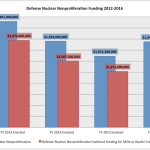
By Greg Terryn and Angela Canterbury For the second year in a row, lawmakers cut funding for programs essential to the United States’ fight against nuclear terrorism. Responsible for monitoring, securing, and removing at-risk radioactive material, nuclear non-proliferation programs limit the ability of rogue states and terrorist organizations to obtain the catalysts for a nuclear […]
Finalizing the FY 2015 National Defense Authorization (NDAA): Key Issues for Congress
For the third year in a row, the United States Senate is unlikely to approve its own version of the critically important Fiscal Year 2015 National Defense Authorization Act (NDAA). So much for being “the world’s greatest deliberative body.” After voting on September 18 on a bill to keep the government running through mid-December and […]