• Skip to main content
  • Skip to primary sidebar
  • Skip to footer

Center for Arms Control and Non-Proliferation

Center for Arms Control and Non-Proliferation

  • Policy Issues
    • Fact Sheets
    • Countries
    • Nuclear Weapons
    • Non-Proliferation
    • Nuclear Security
    • Biological & Chemical Weapons
    • Defense Spending
    • Missile Defense
    • No First Use
  • Nukes of Hazard
    • Podcast
    • Blog
      • Next Up In Arms Control
    • Videos
  • Join Us
  • Press
  • About
    • Staff
    • Boards & Experts
    • Jobs & Internships
    • Financials and Annual Reports
    • Contact Us
  • Donate
  • Search
You are here: Home / Archives for Security Spending

December 18, 2014

Spending Bills Clear Congress, Despite Delays

After more than a few budget antics this weekend, both the FY15 National Defense Authorization Act (NDAA, H.R. 3979) and FY15 Omnibus (H.R. 83), or “Cromnibus,” have cleared Congress.

The House and Senate Armed Services Committees completed behind-the-scenes negotiations on the NDAA on December 1st then moved on to a vote in the House on December 5th, where the bill passed 300-119. On December 12th, the Senate lent its approval to the bill by a vote of 89-11, marking the 53rd consecutive NDAA approved by Congress.

Posted in: Non-Proliferation, Nukes of Hazard blog, Security Spending

December 12, 2014

DoD Buzz Quotes Angela Canterbury on Defense Bill

Critics: Congress Expands ‘Slush Fund’ in Defense Bill December 12, 2014 By Brendan McGarry …Angela Canterbury, executive director of the Center for Arms Control and Non-Proliferation, said the war budget essentially amounts to a slush fund. “This account has effectively become an unaccountable slush fund and a convenient escape from the Budget Control Act spending […]

Posted in: Center in the News, Press & In the News on Pentagon Budget, Press Room

December 5, 2014

Senator Feinstein: U.S. Should Shrink Nuclear Arsenal

Sen. Dianne Feinstein (D-Ca.) provided a thoughtful analysis of the United States’ overstocked nuclear arsenal in the Washington Post this week, drawing attention to its costs and safety burdens. To convey Sen. Feinstein’s argument succinctly: “The current level of spending on nuclear weapons is unnecessary and unsustainable.”

Among the listed concerns of Sen. Feinstein, the size and cost of the arsenal appear front and center. “We’re holding far more nuclear weapons than are necessary, and the cost is undermining other national security priorities.”, Sen. Feinstein says, citing the rising annual costs of maintaining the nuclear arsenal and the potential for $1 trillion in nuclear weapons spending within the next 30 years.  Sen. Feinstein also cites the nuclear hedge, which preserves two reserve warheads for every active duty warhead, as excessive and worthy of reduction.  

Also this week, Sen. Feinstein received an award in recognition of her leadership on nuclear security and non-proliferation. This award was presented to her by nine organizations within the arms control community, including the Center for Arms Control and Non-Proliferation’s sister organization: Council for A Livable World.

Angela Canterbury, executive director of the Council and Center, commended the Senator: “Sen. Feinstein has been a tremendous leader, having worked in a bipartisan manner with Senator Lamar Alexander to conduct much-needed oversight of the nuclear weapons complex. No one in Congress knows these issues better, or is doing more to ensure nuclear security and the right-sizing of the role of these weapons in our overall national security strategy.”

Since 2011, Senator Feinstein has served as Chairman of the Senate Appropriations Energy and Water Subcommittee —the committee that oversees federal spending on most of the nuclear weapons complex, which is managed by the National Nuclear Security Administration under the Department of Energy. Next year, when the Republicans become the majority, Feinstein is expected to serve as Ranking Member of that committee while the current Ranking Member Lamar Alexander (R-TN) is expected to become Chairman. Sen. Alexander has a long history of fighting for nuclear security, including being one of 13 republican senators to vote in favor of the New START Treaty. The two have worked closely together on many issues, including issues of nuclear security.  

With an unnecessarily ambitious nuclear modernization plan and tough budgetary decisions on the horizon, the U.S. cannot afford to allow inertia to dictate nuclear policy. “It’s time we take a long look at how we can responsibly reduce our stockpile”, says Sen. Feinstein. “We live in 2014, not 1980. The world is a very different place, and we need to plan accordingly.” Indeed.

Posted in: Nuclear Weapons, Nuclear Weapons Spending, Nukes of Hazard blog

December 5, 2014

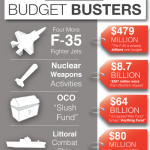
2015 Pentagon Budget Busters

By Amanda Waldron

Posted in: Infographics on Nuclear Weapons Spending, Infographics on Pentagon Budget, Nuclear Weapons Spending, Pentagon Budget, Security Spending

December 3, 2014

Options for Big Savings from CBO

Each year the Congressional Budget Office (CBO) provides a list of options for potential federal budget savings CBO is careful to point out that the options shouldn’t be mistaken for recommendations, but they do serve as a nudge toward careful consideration of the value of these programs and the possibility for savings.

This year the Defense Department’s roster includes the following six options, totaling over $160 billion in budget authority from 2015-2024. Explanations that follow are taken from CBO’s recommendations.

1) Cap increases in pay for military service members.

Savings = $24.1 billion in budget authority, 2015-2024

“Starting in January 2016, this option would cap basic pay, which accounts for about 70 percent of cash compensation for active duty military personnel, to increases of 0.5 percentage points below the percentage increase in the employment cost index (ECI). Use of the ECI is the default for military pay raises under current law.”

CBO cites recent analysis that shows that compensation for enlisted personnel is currently greater than the wages and salaries of 90 percent of their civilian counterparts. Officers earn more than 83 percent of their civilian counterparts.

While smaller pay raises could make it harder to retain personnel, CBO suggests that the impact would be too minor to require additional incentives such as reenlistment bonuses.

2) Replace some military personnel with civilian employees.

Savings = $20.6 billion in budget authority, 2015-2024

“According to data from the Department of Defense (DoD), thousands of members of the military work in support roles or in “commercial” jobs that could be performed by civilians. Under this option, over four years, DoD would replace 80,000 of the more than 500,000 uniformed military personnel in commercial jobs with 53,000 civilian employees and, as a result, decrease military end strength (the number of military personnel on the rolls as of the final day of a fiscal year) by 80,000. Those changes would reduce the need for appropriations primarily because fewer civilians would replace a given number of military personnel. (Civilians have fewer collateral duties and do not generally rotate among positions as rapidly as military personnel do.)”

According to CBO, this option could result in decreases in job-specific training, since civilians are not subject to the same frequent transfers as military personnel. This advantage relies, however, on the assumption that greater efficiency could be achieved with fewer personnel. If end strength is not also reduced, total personnel costs could increase.

3) Replace the Joint Strike Fighter program with F-16s and F/A-18s.

Savings = $41.0 billion in budget authority, 2015-2024

“The Department of Defense (DoD) has ordered 179 F-35 Joint Strike Fighters and plans to purchase 2,264 more. Under this option, DoD would cancel the F-35 program and instead purchase the most advanced versions of fighter aircraft already in service. The Air Force would acquire 1,763 Lockheed Martin F-16s, and the Navy and Marine Corps would buy 680 Boeing F/A-18s.”

CBO notes that if equipped with upgraded radar, precision weapons, and digital communications, new F-16s and F/A-18s would be sufficient to meet the threats that the United States is likely to face in the future. Unfortunately, CBO says, the “extreme sophistication” of the F-35 has contributed to cost growth and schedule delays. Lesser technical challenges related to F-16s and F/A-18s would be less likely to incur such growth.

One disadvantage of this option is that F-16s and F/A-18s aircraft lack stealth capability, but the Air Force would maintain such capability in the B-2 and F-22.

4) Stop building Ford Class Aircraft Carriers.

Savings = $19.9 billion in budget authority, 2015-2024

“Under this option, the Navy would stop building new aircraft carriers after completion of the U.S.S. John F. Kennedy, which lawmakers authorized in 2013. (All years mentioned in this option are fiscal years.) Thus, the next two aircraft carriers the Navy intends to purchase under its shipbuilding plan, the U.S.S. Enterprise in 2018 and another carrier in 2023, would be canceled.”

According to CBO, because they are designed to operate for 50 years, the current fleet and carriers under construction could sustain the size of the carrier force for many years. Further, at some point in the near future, the large aircraft carrier may no longer be considered an effective weapons system. Long-range supersonic antiship cruise missiles, antiship ballistic missiles, quiet submarines, and satellite tracking systems could all threaten the future survivability of the ship.

CBO points out, however, that the aircraft carrier has been the centerpiece of the U.S. Navy since WWII and, with the development of new technology, could prove adaptable to future threats.

5) Reduce the number of Ballistic Missile Submarines.

Savings = $20.9 billion in budget authority, 2015-2024

“The Navy maintains a force of 14 Ohio class ballistic missile submarines (SSBNs). Over the next two decades, the Ohio class submarines will reach the end of their service life. This option would reduce the Navy’s SSBN force to eight submarines in 2021 by retiring one Ohio class submarine a year over the 2016–2021 period. (All years mentioned in this option are fiscal years.) That number would be maintained after 2021 by delaying the start of the Ohio Replacement program from 2021 to 2025 and reducing the number of SSBNs purchased under that program.”

Because a reduction in the number of missiles would not dramatically reduce the total number of warheads that could be deployed, CBO reasons that reducing the SSBN force to eight submarines “would still provide a robust strategic deterrent at sea.” As a bonus, costs associated with extending the service lives of missiles and warheads could be avoided because the SSBNs would be carrying less.

The counterargument to this is that fewer boats would be available for quick deployment in a crisis.

6) Defer development of a new Long-Range Bomber.

Savings = $34.2 billion in budget authority, 2015-2024

“This option would defer until at least fiscal year 2025 the Air Force’s program to develop a new bomber to augment and eventually replace its current fleet of 159 long-range bombers.”

The primary advantage to this option, according to CBO, is that deferment would free up budgetary resources to focus on more pressing needs. As a bonus, a program that begins later could take advantage of newer technology.

One disadvantage is that if service life estimates of current bombers prove to be incorrect or a new bomber takes significantly longer than expected, a capability gap could arise.

Posted in: Nukes of Hazard blog, Pentagon Budget, Uncategorized

  • « Go to Previous Page
  • Page 1
  • Interim pages omitted …
  • Page 41
  • Page 42
  • Page 43
  • Page 44
  • Page 45
  • Interim pages omitted …
  • Page 85
  • Go to Next Page »

Primary Sidebar

Recent Posts

  • Does the Trump administration understand how ‘enriched’ uranium is made into weapons? April 1, 2026
  • Will the Iran war set off a new nuclear arms race? “No one speaks of taking out Kim Jong Un” March 25, 2026
  • Front and Center: March 22, 2026 March 22, 2026
  • Why Did the United States Lift Sanctions on Assad’s Chemical Weapons Scientists? March 20, 2026
  • Iran’s Stockpile of Highly Enriched Uranium: Worth Bargaining For? March 16, 2026

Footer

Center for Arms Control and Non-Proliferation

820 1st Street NE, Suite LL-180
Washington, D.C. 20002
Phone: 202.546.0795

Issues

  • Fact Sheets
  • Countries
  • Nuclear Weapons
  • Non-Proliferation
  • Nuclear Security
  • Defense Spending
  • Biological and Chemical Weapons
  • Missile Defense
  • No First Use

Countries

  • China
  • France
  • India and Pakistan
  • Iran
  • Israel
  • North Korea
  • Russia
  • United Kingdom

Explore

  • Nukes of Hazard blog
  • Nukes of Hazard podcast
  • Nukes of Hazard videos
  • Front and Center
  • Fact Sheets

About

  • About
  • Meet the Staff
  • Boards & Experts
  • Press
  • Jobs & Internships
  • Financials and Annual Reports
  • Contact Us
  • Council for a Livable World
  • Twitter
  • YouTube
  • Instagram
  • Facebook

© 2026 Center for Arms Control and Non-Proliferation
Privacy Policy

Charity Navigator GuideStar Seal of Transparency