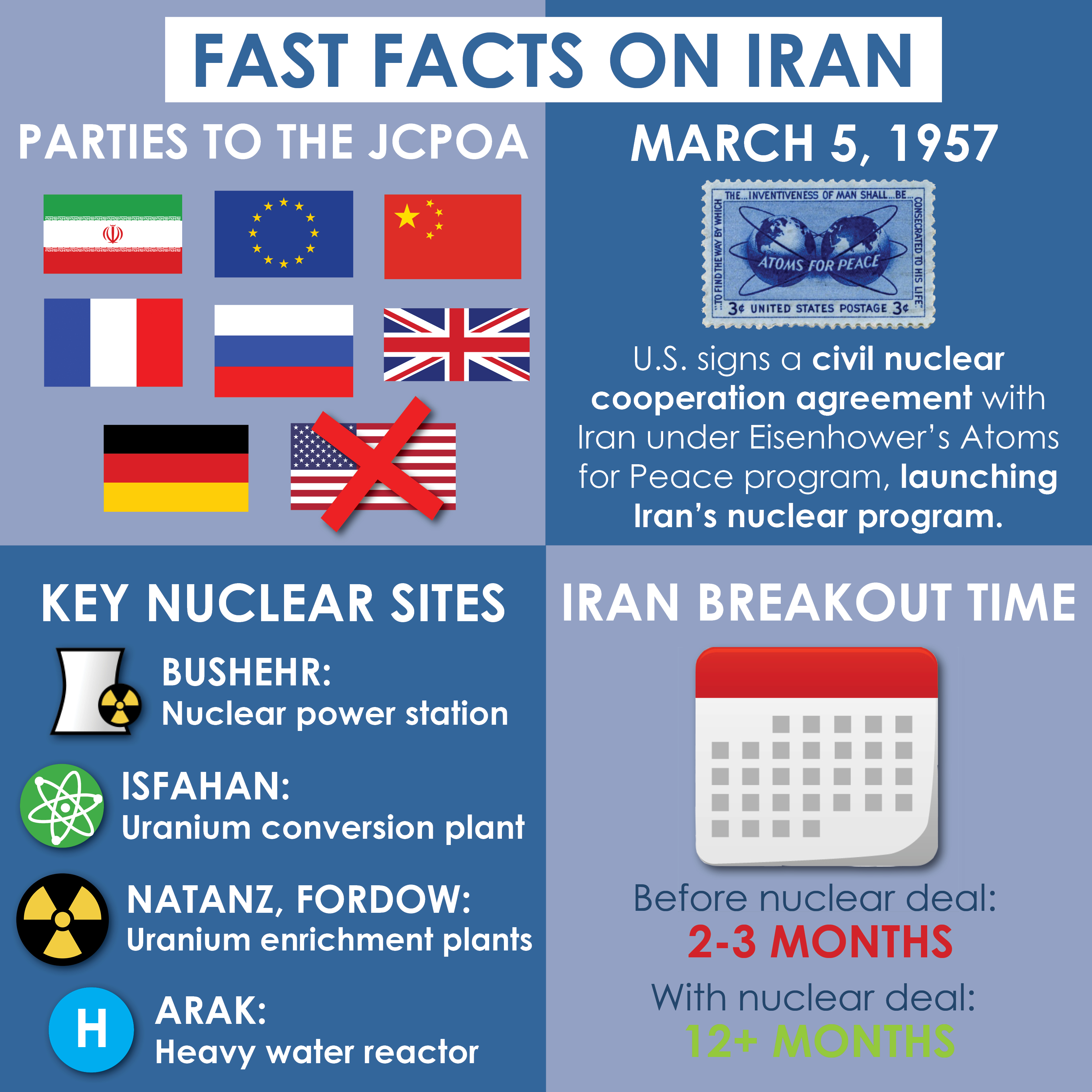
 Beginning formally in 2013, nations of the P5+1 (the United States, France, the United Kingdom, China, Russia, plus Germany) and the European Union engaged in diplomatic negotiations with Iran to address the international community’s concerns over Iran’s nuclear program.
On July 14, 2015, after two years of negotiations, the P5+1 and the European Union announced the Joint Comprehensive Plan of Action (JCPOA) to prevent Iran from obtaining a nuclear weapon. Under the agreement, known as the Iran nuclear deal, Iran significantly reduced its nuclear program and accepted strict monitoring and verification safeguards to ensure its program is solely for peaceful purposes. In exchange, Iran received economic sanctions relief from nuclear-related sanctions (all other sanctions remained in place), but only after the International Atomic Energy Association (IAEA) verified that Iran had completed its initial requirements under the agreement.
In May 2018, former President Donald Trump pulled the United States out of the JCPOA without cause and re-imposed nuclear-related sanctions on Iran. Up until May 2019, a full year after the United States withdrew from the deal, the IAEA routinely verified that Iran was in full compliance under the JCPOA. After that, Iran began incrementally stepping back from compliance with the deal while the other parties to the agreement have remained committed to its implementation. Since the United States abrogated the deal and Iran in turn stopped honoring some of its commitments, Iran has reduced its breakout time — the amount of time it would take to accumulate enough fissile material for a nuclear weapon — from more than a year to about 3-4 months, although the IAEA remains on the ground to verify the peaceful nature of its nuclear program.
The Center for Arms Control and Non-Proliferation works within a broad coalition of organizations to support this diplomatic non-proliferation effort. Our experts recommend that the United States returns to compliance with the JCPOA as it is the only responsible pathway to verifiably constrain Iran’s nuclear program.


Recent Analysis on Iran
- After US and Israeli strikes, some nuclear experts say Iran could be more dangerous July 2, 2025
- How Iran could build a bomb in secret – despite Trump’s $30bn offer June 27, 2025
- Dall’attacco all’Iran ai record a Wall Street June 26, 2025
- Ceasefire holds steady with a looming concern of Iran’s nuclear capabilities June 26, 2025
- Does Iran’s nuclear program survive under the rubble? June 26, 2025
- Bloomberg Businessweek Daily: Duped Into Funding Coup June 25, 2025
- Fact Sheet: Facilities Related to Iran’s Nuclear Weapons Program June 25, 2025
- Uncertainty surrounds the fate of Iran’s nuclear program June 25, 2025
- Iran could still build a dirty bomb – but it would spell disaster for the regime June 25, 2025
- Iranian Nuclear Program Damaged, Not ‘Obliterated’ by U.S. Attack June 24, 2025