• Skip to main content
  • Skip to primary sidebar
  • Skip to footer

Center for Arms Control and Non-Proliferation

Center for Arms Control and Non-Proliferation

  • Policy Issues
    • Fact Sheets
    • Countries
    • Nuclear Weapons
    • Non-Proliferation
    • Nuclear Security
    • Biological & Chemical Weapons
    • Defense Spending
    • Missile Defense
    • No First Use
  • Nukes of Hazard
    • Podcast
    • Blog
      • Next Up In Arms Control
    • Videos
  • Join Us
  • Press
  • About
    • Staff
    • Boards & Experts
    • Jobs & Internships
    • Financials and Annual Reports
    • Contact Us
  • Donate
  • Search
You are here: Home / Archives for New National Security

October 23, 2014

Panetta’s Loose Words Warrant Washing His Mouth Out With Soap

This month, former CIA director and Secretary of Defense Leon Panetta – he of minimal loyalty to his bosses — published his memoir “Worthy Fights,” in which he criticizes Obama’s national security strategies and in particular how the administration has dealt with Iraq and Syria.  

In his book, Panetta decries the “Red line” debacle of 2012 when President Obama said that the use of chemical weapons in Syria was a “red line for us.” Panetta suggests that Obama’s failure to enforce the red line, when chemical weapons really were used a year later, undermined U.S. credibility amongst Syrians and the rest of the world.

Ironically, Panetta’s book makes a serious semantic blunder of its own when Northeast Asian news outlets took a keen interest in this sentence:

“If North Korea moved across the border, our war plans called for the senior American general on the peninsula to take command of all U.S. and South Korean forces and defend south Korea – including by the use of nuclear weapons, if necessary.”

The sentence garnered attention from South Korean media and even prompted a response from Pyongyang, which promised to bolster their nuclear deterrent to counter the U.S. policies toward North Korea.

World order hanging in the balance of your every word is pretty difficult, isn’t it, Mr. Panetta?

The importance of rhetoric cannot be overplayed. Need you be reminded of the infamous “16 words” (“the British government has learned that Saddam Hussein recently sought significant quantities of uranium from Africa.”) spoken by President Bush in his 2003 State of the Union address that were used to justify war in Iraq.

Or Ronald Reagan’s joke before a Saturday radio address: “My fellow Americans, I’m pleased to tell you today that I’ve signed legislation that will outlaw Russia forever. We begin bombing in five minutes.”

Panetta’s words are alarmist. Threatening the use of nuclear weapons in the event of a conventional attack only heightens the importance of these weapons that should only serve as a nuclear deterrent.  

If there is a North Korean conventional attack on South Korea, the United States has ample non-nuclear means at its disposal to respond. According to Lt. General (USA, Ret.) Robert G. Gard, Jr., Chair of the Center for Arms Control & Non-Proliferation, U.S. conventional weapons would be sufficient to defend South Korea from North Korean forces.

Gard writes, “Stopping the attack of poorly trained and ill-equipped North Korean forces does not require the use of nuclear weapons.”

He goes on to say, “Should North Korea be able to bypass the demilitarized zone by moving some troops by air or through tunnels into South Korea, an option that has been threatened, they obviously would have to be killed or captured by conventional means. Employing nuclear weapons in densely populated South Korea brings to memory the parallel concept of destroying a city in order to save it. And since the war plan for defense of South Korea envisions invading North Korea and seizing Pyongyang, the capitol, attacking the North with nuclear weapons would endanger our own troops, as well as causing massive casualties on the long-suffering North Korean population.

“There is no justification for threatening to break the generally accepted barrier between the use of conventional high explosive munitions and nuclear weapons in the defense of South Korea. The only practical utility of U.S. nuclear weapons is to deter their use by other nations against our vital national interests and, by extension, against our allies,” concluded Gard.

Perhaps Panetta’s ill-considered words deserve the old bar of soap to the mouth treatment a la Ralphie in “A Christmas Story.”  
Posted in: New National Security, Nuclear Weapons, Nukes of Hazard blog

September 18, 2014

Letter to the Department of Energy Regarding Termination of Dr. James Doyle

The Center for Arms Control and Non-Proliferation and Council for a Livable World signed onto a letter censuring the Department of Energy for improper handling of the termination of Dr. James Doyle, a former employee of the Los Alamos National Laboratory who spoke out against nuclear deterrence. Sep 18, 2014 The Honorable Ernest Moniz Secretary […]

Posted in: Letters and Publications, New National Security, Press Room

September 18, 2014

Letter to Secretary Moniz and Inspector General Friedman on Dr. Doyle Case

Angela Canterbury, Executive Director of the Center for Arms Control and Non-Proliferation, signed onto a letter expressing concern toward the procedures of the ongoing case of Dr. James Doyle, who was terminated from the Los Alamos National Laboratory. Sep 18, 2014 The Honorable Ernest Moniz Secretary Department of Energy 1000 Independence Avenue, SW Washington, DC […]

Posted in: Letters and Publications, New National Security, Nuclear Weapons, Press & In the News on Nuclear Weapons, Press Room

September 10, 2014

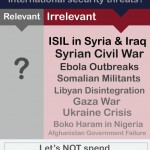
Nuclear Weapons: Irrelevant to Security Crises

Posted in: Infographics on Nuclear Weapons, Infographics on Nuclear Weapons Spending, New National Security, Nuclear Weapons, Nuclear Weapons Spending, Security Spending

July 25, 2014

Leading National Security Organizations Applaud Bipartisan House Vote to Check Military Engagement in Iraq

Today, Council for a Livable World and the Center for Arms Control and Non-Proliferation praised an overwhelming vote in the House of Representatives to require approval by Congress of expanded military involvement in Iraq. This was the first congressional expression of view on another potential war in that country.

Posted in: Middle East, New National Security, Press & In the News on the Middle East, Press Releases, Press Room

  • « Go to Previous Page
  • Page 1
  • Interim pages omitted …
  • Page 8
  • Page 9
  • Page 10
  • Page 11
  • Page 12
  • Interim pages omitted …
  • Page 22
  • Go to Next Page »

Primary Sidebar

Recent Posts

  • Summary: Fiscal Year 2027 National Defense Authorization Act (H.R. 8800) as passed by the House Committee on Armed Services June 24, 2026
  • France’s New Nukes and the Future of European Security June 8, 2026
  • Introducing the Newest Member of the Center Team: Conor Donlevy May 26, 2026
  • The Charge of the Silicon Brigade May 22, 2026
  • Front and Center: May 17, 2026 May 17, 2026

Footer

Center for Arms Control and Non-Proliferation

820 1st Street NE, Suite LL-180
Washington, D.C. 20002
Phone: 202.546.0795

Issues

  • Fact Sheets
  • Countries
  • Nuclear Weapons
  • Non-Proliferation
  • Nuclear Security
  • Defense Spending
  • Biological and Chemical Weapons
  • Missile Defense
  • No First Use

Countries

  • China
  • France
  • India and Pakistan
  • Iran
  • Israel
  • North Korea
  • Russia
  • United Kingdom

Explore

  • Nukes of Hazard blog
  • Nukes of Hazard podcast
  • Nukes of Hazard videos
  • Front and Center
  • Fact Sheets

About

  • About
  • Meet the Staff
  • Boards & Experts
  • Press
  • Jobs & Internships
  • Financials and Annual Reports
  • Contact Us
  • Council for a Livable World
  • Twitter
  • YouTube
  • Instagram
  • Facebook

© 2026 Center for Arms Control and Non-Proliferation
Privacy Policy

Charity Navigator GuideStar Seal of Transparency