• Skip to main content
  • Skip to primary sidebar
  • Skip to footer

Center for Arms Control and Non-Proliferation

Center for Arms Control and Non-Proliferation

  • Policy Issues
    • 25 Years Since September 11
    • Fact Sheets
    • Biological & Chemical Weapons
    • Countries
    • Defense Spending
    • No First Use
    • Non-Proliferation
    • Nuclear Security
    • Nuclear Testing
    • Nuclear Weapons
    • Missile Defense
  • Nukes of Hazard
    • Podcast
    • Blog
      • Next Up In Arms Control
    • Videos
  • Join Us
  • Press
  • About
    • Staff
    • Boards & Experts
    • Jobs & Internships
    • Financials and Annual Reports
    • Contact Us
  • Donate
  • Search
You are here: Home / Archives for Security Spending / Nuclear Weapons Spending

October 16, 2014

Front and Center: An Update on Arms Control, National Security and Politics

FRONT & CENTER

An update on arms control, national security & politics from the Center for Arms Control and Non-Proliferation.

WHAT’S NEW:

We’re Hiring!
Know any accounting experts interested in working at a mission-oriented non-profit? Because the Center and Council are looking for a full-time financial controller to join our team. Please share the job description–applications are due by October 20!

READ:

Planes, Trains, and Mobile-Basing?
Cold War ideas of where to house our nuclear weapons—such as hiding missiles on trains and trucks—are beginning to re-surge. Writing on the Center blog, Scoville Fellow Greg Terryn reminds us that “mobile-basing”—like nuclear weapons themselves—is an expensive and dangerous idea that is better left in the past. [10/2]

Don’t Forget About the Other ‘Rogue State’:
For over a year, the U.S. has been all eyes on Iran, but is this distracting us from states that already have nuclear weapons—such as the ever-unpredictable North Korea? On the blog, Sarah Tully suggests that the DPRK’s nuclear program is “flying under the radar” while the U.S. spends its days engaging Iran and refusing to engage North Korea. [10/2]

Who’s Minding the Nukes?
It’s no secret our nuclear weapons enterprise has been under fire this year for a truly inexcusable culture of complacency. Katie McCarthy underlines the irony that poor management in the NNSA has arisen despite the NNSA’s initial mission: to escape poor management. However, the incoming NNSA director, Frank Klotz, may come as a ray of hope for much-needed reform. [10/3]

BE SOCIAL:

Almost to 5,000 Followers!
Just last week, the National Security Council’s WMD advisor cited the Nukes of Hazard Twitter handle and blog as an “expert source” at the Military Reporters & Editors Conference. Make sure you follow Nukes_of_Hazard on Twitter for all your nuclear and national security related news!

ICYMI: the Iran Talks on Buzzfeed
When it comes to these complex international negotiations, sometimes it helps to dumb down the wonk for a moment and just have some fun. That’s why we teamed up with our friends at Win Without War to break down the talks with quotes from the 2004 hit film, Mean Girls. If you’re ready for a laugh, check out our BuzzFeed article—and don’t forget to give it a share on Facebook and Twitter!

Posted in: Nuclear Weapons, Nuclear Weapons Spending, Nukes of Hazard blog

September 25, 2014

It’s Time To Rein In Nuclear Spending

Running with the anti-nuclear-spending momentum generated by the New York Times article, Angela Canterbury and Kingston Reif teamed up to weigh in on the debate. Their published article in Defense One echoes united calls from the community for profound spending cuts, but they also assess the issue through the Council’s unique perspective as a political action committee: namely, how Congress can andmust pull the purse strings tighter on nuclear weapons spending. [9/25]

Posted in: Nuclear Weapons, Nuclear Weapons Spending, Press & In the News on Nuclear Weapons, Press & In the News on Nuclear Weapons Spending, Security Spending

September 10, 2014

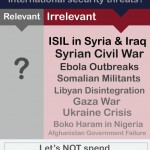
Nuclear Weapons: Irrelevant to Security Crises

Posted in: Infographics on Nuclear Weapons, Infographics on Nuclear Weapons Spending, New National Security, Nuclear Weapons, Nuclear Weapons Spending, Security Spending

August 25, 2014

Two new nuclear weapons budget pieces

Since returning from paternity leave I’ve penned two new pieces on the issue of the costs of nuclear weapons. The first, published in RealClearDefense, assesses the conclusions of the recently released report of the National Defense Panel Review of the 2014 Quadrennial Defense Review on the costs of nuclear weapons. Here’s how I end the piece:

The NDP [National Defense Panel] recognizes that current resources don’t match requirements. The longer current nuclear spending plans remain on autopilot, the more likely it will be that the budget will force suboptimal tradeoffs between nuclear and other national security programs, as well as possible reductions in nuclear forces by financial default. Fortunately, the United States can guarantee its security and that of its allies in a more fiscally sustainable manner by continuing to pursue further reductions in U.S. nuclear forces and scaling back current modernization plans.

Read the whole thing here.

The second piece rebuts the oft-repeated claim by some Air Force nuclear leaders that the cost of the Air Force nuclear enterprise is relatively cheap. Here’s an excerpt:

While the current costs of the Air Force legs of the triad may be cheaper than some other Pentagon programs, these aren’t the only costs. For example, Harencak’s one-year tally ignores the large financial and opportunity costs of current plans to modernize and recapitalize all elements of the Air Force nuclear enterprise, the bulk of which have yet to (but will soon) hit the balance sheets. While the Air Force has been less than transparent about the extent of the bill, it has already acknowledged these costs will be substantial. So substantial, in fact, that the service leadership is looking for assistance from elsewhere in the Pentagon to help pick up the tab.

The entire piece is available here.

Posted in: Nuclear Weapons Spending, Nukes of Hazard blog, Security Spending

August 18, 2014

26 Senators sign letter to Obama administration urging increased nuclear security funding

Earlier today (August 18) Senators Jeff Merkley (D-OR) and Feinstein (D-CA) released a bipartisan letter calling on the Obama administration to support increased funding for vital programs at the Department of Energy to keep nuclear and radiological materials out of the hands of terrorists. The full text of the letter is pasted below the jump. You can read the Merkley and Feinstein press release announcing the letter here.

26 Senators signed the letter, including 22 Democrats, 2 Independents, and 2 Republicans.

The Center for Arms Control and Non-Proliferation and Council for a Livable World strongly support the letter’s message and urge the White House to act on this bipartisan call for increased funding to prevent nuclear and radiological terrorism.

The Obama administration’s recent budget requests have not reflected the rhetorical emphasis it has rightly placed on combatting nuclear terrorism. The FY 2015 budget request for the National Nuclear Security Administration (NNSA) reduces funding for the Global Threat Reduction Initiative (GTRI) and the International Nuclear Materials Protection Program (IMPC) by 25% and 27%, respectively, signaling a major retreat in the Obama administration’s effort to secure nuclear and radiological materials at an accelerated rate. This is the third year in a row of budget cuts to these core nonproliferation programs. The proposed budget cuts to these programs are difficult to understand since the danger of nuclear and radiological materials falling into the hands of terrorists remains a serious threat.

Reducing funding for these programs increases the amount of time it will take to secure or eliminate dangerous materials that could be used by terrorists in an improvised nuclear explosive device or a dirty bomb. This is an unacceptable risk to U.S. national security. Important nuclear security efforts should not be slowed by lack of funds.

Fortunately, both the Senate Armed Services Committee and the Senate Energy and Water Appropriations Subcommittee significantly increased funding above the budget request for NNSA’s core material security and nonproliferation programs. However, it remains to be seen if these higher funding levels will survive and whatever final authorization and appropriations bill is passed by Congress for FY 2015.

For more information on the budget cuts, see our handy fact sheet. For a more detailed discussion of the Obama administration’s nuclear security request and the harmful impacts of budget cuts, see this excellent recent report by Harvard’s Managing the Atom Project co-authored by Nukes of Hazard alum Nickolas Roth.

August 13.2014

Mr. Shaun Donovan
Director
Oftice of Management and Budget
725 I th St NW
Washington, DC 20503

Dear Director Donovan,

We write to request the Administration, in its next budget request, seek increased funding for vital nuclear material security and nonproliferation programs. We have been concerned that the President has proposed cuts to these programs over the last several years. We believe that unsecured nuclear material poses an unacceptable risk to U.S. national security and hope future budgets will reflect the importance of nuclear security efforts.

The President has said that nuclear terrorism is the most immediate and extreme threat to global security.” He followed these words by hosting the first Nuclear Security Summit in 2010. While we applaud the President’s leadership in spearheading an accelerated international effort to enhance the security of nuclear and radiological materials, we remain concerned about what the future would look like if we slow these programs. For example, through programs such as the Global Threat Reduction Initiative (GTRI), thirteen countries eliminated all the highly enriched uranium (HEU) or separated plutonium on their soil since 2009, including all HEU from Ukraine. I applaud those efforts been slowed by anemic funding, it is possible that the United States would face the threat of weapons-grade nuclear material in the hands of Ukrainian separatists.

Despite these noteworthy achievements, significant work remains to be done. There are still
hundreds of sites spread across 30 countries that have weapons-usable nuclear material. Many of these locations have very modest or insufficient security measures. For these reasons and others. the FY 201 5 Senate Energy and Water bill increased funding for these programs above the President’s budget request by $136 million for the GTRI, $33 million for research and development, and $50 million for the International Nuclear Materials Protection and Cooperation program.

Reducing budgets for agencies and programs that help keep nuclear and radiological materials out of the hands of terrorists is out of sync with the high priority that President has rightly placed on nuclear and radiological material security and signals a major retreat in the effort to lock down these materials at an accelerated rate. The recent spate of terrorism in Iraq, Pakistan, and Kenya is a harrowing reminder of the importance of ensuring that terrorist groups and rogue states cannot get their hands on the world’s most dangerous weapons and materials.

Given current world events, now is not the time to pull back on nonproliferation, a major U.S.
policy objective. Going forward, we urge you to work with us to ensure that critical nuclear
material security and nonproliferation programs have the resources they need. We seek your
support for a FY 2016 budget that builds on the Senate Energy and Water proposed FY 2015 funding levels to further accelerate the pace at which nuclear and radio logical materials are secured and permanently disposed.

Sincerely-

Posted in: Non-Proliferation, Nuclear Weapons Spending, Nukes of Hazard blog, Security Spending

  • « Go to Previous Page
  • Page 1
  • Interim pages omitted …
  • Page 31
  • Page 32
  • Page 33
  • Page 34
  • Page 35
  • Interim pages omitted …
  • Page 48
  • Go to Next Page »

Primary Sidebar

Recent Posts

  • Introducing: Neighbors Against Nukes October 1, 2026
  • BONUS Episode: The Costs of False Security – Live Audience Question & Answer Session September 30, 2026
  • Time To Fund the OPCW September 29, 2026
  • The Costs of False Security: The Fallacy of National Missile Defense, the Golden Dome and Nuclear Weapons in Space September 28, 2026
  • 2026 Annual Conference: $1 Trillion and Counting: The Pentagon Budget Squeezing Our Real Security September 16, 2026

Footer

Center for Arms Control and Non-Proliferation

820 1st Street NE, Suite LL-180
Washington, D.C. 20002
Phone: 202.546.0795

Issues

  • 25 Years Since September 11
  • Fact Sheets
  • Biological and Chemical Weapons
  • Countries
  • Defense Spending
  • No First Use
  • Non-Proliferation
  • Nuclear Security
  • Nuclear Testing
  • Nuclear Weapons
  • Missile Defense

Countries

  • China
  • France
  • India and Pakistan
  • Iran
  • Israel
  • North Korea
  • Russia
  • United Kingdom

Explore

  • Nukes of Hazard blog
  • Nukes of Hazard podcast
  • Nukes of Hazard videos
  • Front and Center
  • Fact Sheets

About

  • About
  • Meet the Staff
  • Boards & Experts
  • Press
  • Jobs & Internships
  • Financials and Annual Reports
  • Contact Us
  • Council for a Livable World
  • Twitter
  • YouTube
  • Instagram
  • Facebook

© 2026 Center for Arms Control and Non-Proliferation
Privacy Policy

Charity Navigator GuideStar Seal of Transparency